
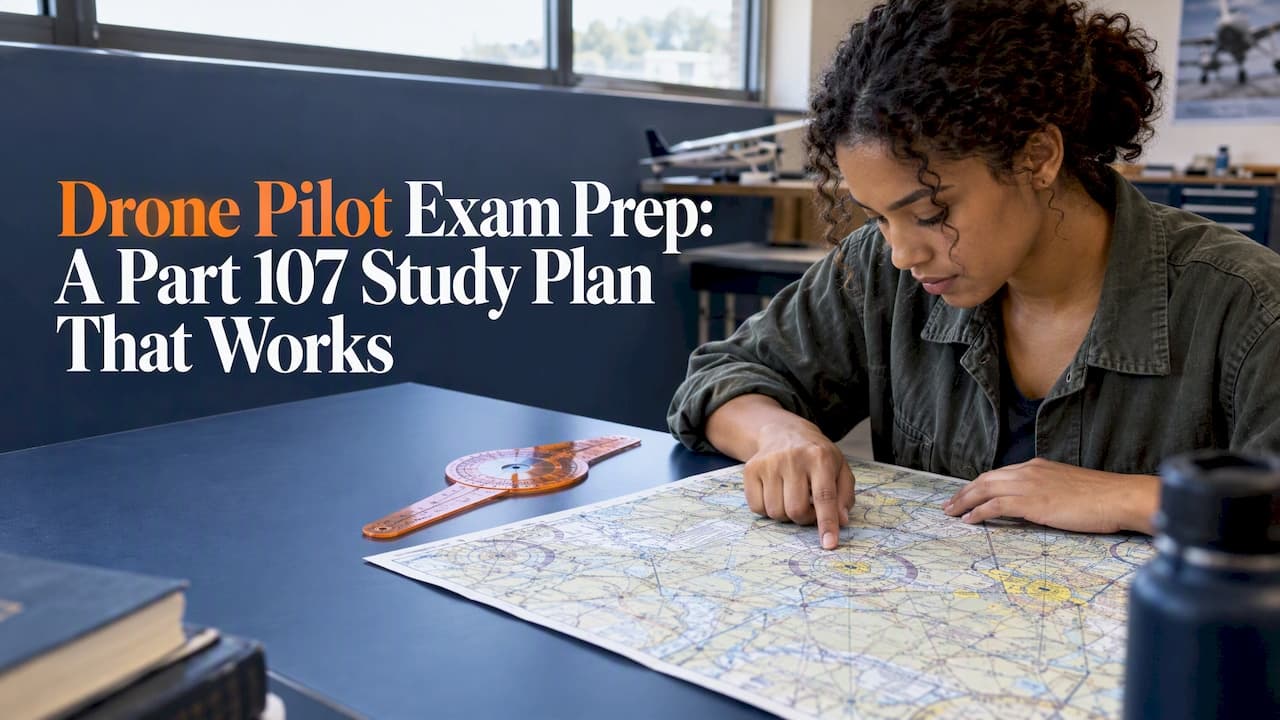
The best way to prepare for the FAA drone pilot exam is to learn the knowledge areas from official material, then spend most of your time on practice questions and review every miss until you can explain it. The test is 60 multiple-choice questions, you need 70% to pass, and you can retake it if you fall short. What separates people who pass from people who retake is usually not talent. It is whether they found their weak topics before test day.
This guide walks through what the exam covers, a study plan you can adapt to two weeks or two months, how to use practice tests, what to do on test day, and what happens if you need a retake.
TL;DR
- The Part 107 knowledge test has 60 questions, a two-hour limit and a 70% passing score (42 correct answers).
- Regulations, airspace, weather and operations make up the exam. Learn to read a sectional chart early.
- Use practice tests to find weak topics, then reread the source material for those topics only.
- If you fail, you can retake after 14 calendar days. You pay the fee again, and there is no cap on attempts.
- Bring a valid government-issued photo ID. The test runs on a computer at an FAA-approved testing center.
Table of Contents
- What the Part 107 exam is and who can take it
- How hard is the drone pilot exam?
- Build your study plan
- Study tips that save time
- How to use practice tests to find weak areas
- Test-day checklist
- What if you fail? Part 107 retake rules
- Choosing a prep plan
- FAQ
- Sources
What the Part 107 exam is and who can take it
The Part 107 knowledge test is officially called the Unmanned Aircraft General – Small (UAG) exam. Pass it and you can apply for a Remote Pilot Certificate, which lets you fly a small drone commercially in the United States.
According to the FAA's certification page, applicants must be at least 16 years old, fluent in English and in a physical and mental condition that allows safe operation. You can sit the exam earlier: candidates may test from age 14, though the certificate cannot be issued until 16.
If you already hold a Part 61 manned pilot certificate and a current flight review, you may not need the initial test at all. The FAA says those pilots can complete online recurrent training instead. Everyone else takes the knowledge test.
How hard is the drone pilot exam?
It is a manageable exam with a few topics that trip people up. You need 42 of 60 questions correct, which is 70%, within two hours. That leaves room for 18 misses, so you do not need perfection. You need no large blind spot.
The FAA lists the topics as:
- Part 107 regulations and operating requirements
- Airspace classification and flight restrictions
- Weather sources and their effects
- Drone performance and loading
- Emergency procedures
- Crew resource management
- Radio communication
Regulations carry the most weight. One test-prep publisher reports that, as of September 29, 2025, regulations account for about 48% of the exam, roughly 29 of the 60 questions. Treat that as a guide to where your hours should go, and confirm the current blueprint in the FAA's own materials.
The hardest parts for most first-time candidates are the ones that feel unfamiliar if you have never flown a manned aircraft: reading sectional charts, decoding METARs and TAFs, and working through density altitude and weight-and-balance logic. Regulations, by contrast, are mostly memorization with some judgment.

Build your study plan
A good plan starts from what you already know and how much time you have. That is the advice of one Part 107 training provider, which also recommends learning airspace heights on sectional charts early. Here is a plan built on that logic. Scale the weeks to your schedule.
Step 1: Take a cold practice test
Before you read anything, take a practice test with no preparation. Your score is not the point. The point is a map of which knowledge areas cost you points. A pilot with an aviation background will see a very different map from someone who has never opened a sectional.
Step 2: Learn the material in order of weight
Spend your first block on regulations and operating rules, because they are the biggest share of the test. Next go to airspace and charts, then weather, then performance and loading, then emergency procedures and crew resource management.

Use official sources as your base. The FAA publishes a Remote Pilot study guide organized by the knowledge areas on the test. Note that this edition is dated 2016, so pair it with the current Airman Certification Standards, which break down every knowledge item and point to the reference document for each.
Step 3: Make airspace and charts a daily habit
Chart reading does not stick from a single session. Spend ten minutes a day on it: find an airport, identify the airspace class, read the ceiling and floor of the shelf, then say aloud whether you could fly there and what authorization you would need. Repetition is what turns this from the most feared topic into a reliable source of points.
Step 4: Switch to practice questions
Once you have covered each area once, move to practice questions. Do short topic sets first, then timed full-length tests. Section below on how to use them.
Step 5: Review, then retest
In the last week, reread only the topics you keep missing. Sit at least one full-length test under timed conditions, with the same two-hour limit you will face on the day.
Sample timelines
| Time available | Weeks 1–2 | Weeks 3–4 | Final stretch |
|---|---|---|---|
| 2 weeks, 1–2 hours a day | Cold test, regulations, airspace, charts | Weather, performance, emergency; topic sets | Two timed full tests, review misses |
| 4 weeks, 4–5 hours a week | Cold test, regulations, charts basics | Airspace, weather, loading; topic sets | Timed tests, review misses |
| 8 weeks, 3 hours a week | Cold test, regulations | Airspace and charts, weather | Performance, emergency, then weekly timed tests |
Study tips that save time
- Study your misses, not your hits. Re-answering questions you already know feels productive and teaches nothing.
- Explain every answer. If you cannot say why three choices are wrong, you have memorized a question, not a concept.
- Draw it out. For performance, loading and weather questions, sketch the situation. Many errors come from rushing the setup.
- Learn the numbers once. Altitude limits, distances, visibility and cloud clearance minimums come up in several forms. Put them on a single page and review it daily.
- Practice with the chart supplement open. Questions use figures and charts, so practice reading them rather than just reading about them.
- Do not cram the night before. Sleep helps recall more than another hour of flashcards.
How to use practice tests to find weak areas
Practice questions are most useful when they tell you which topics to revisit, and timed mock exams are how you rehearse the real test. Use them in three passes.
- Diagnose. Take the cold test and sort every miss by knowledge area.
- Remediate. Study the weakest area, then take a short topic-only set. Repeat until misses in that area drop.
- Simulate. Take full-length timed tests and watch for pacing as well as score. Two hours for 60 questions is generous, but chart questions take longer.
How high should your practice scores be? One state government resource says that 90% on sample tests means no problem on the real exam. Since the pass mark is 70%, a steady score well above that on varied questions gives you a comfortable margin. Aim for consistency across several tests rather than one good result.
Where AMT Guides fits
We built our platform around the idea that a score alone does not help you. What helps is knowing which topics you miss most and getting help when a concept stays unclear. Our practice tests for A&P and Part 107 Remote Pilot include timed full-length and topic-specific tests, question explanations and high-miss topic tracking, with instructor support when you need it.
Our perspective on exam prep
We prepare students for FAA knowledge exams, and the pattern is the same across certificates. Students rarely fail because they studied too little. They fail because they studied evenly. Time goes to topics they already like, and the two or three topics that quietly cost them points get a glance.
That is why we put performance tracking and targeted remediation at the center of the platform, for individuals and for classrooms. When you can see your high-miss topics, your study hours stop being a guess. When an instructor can see the same data for a whole cohort, a class period becomes a response to what students actually missed.
Our advice for any Part 107 candidate: take a practice test early, treat every wrong answer as a lesson, and do not book the exam until your timed scores are consistently strong. A practice test is a diagnostic tool before it is a rehearsal.
the author
Test-day checklist
The exam is given on a testing-center computer, so you bring no device of your own, but you do need valid government-issued photo ID. The same source says the exam is administered electronically at an FAA-approved center, proctored by staff, and that the fee is typically around $175. Fees are set by the testing center, so confirm the amount when you book.
A simple routine for the day:
- Book a time when you are normally alert, not after a shift.
- Arrive early with your ID and read the center's rules before you start.
- On the first pass, answer what you know and flag the rest. Chart and weather questions are better handled with a clear head and the clock in view.
- Read each question twice. Many wrong answers come from missing a word such as "not" or "except".
- Use leftover time to recheck flagged questions, but change an answer only when you can state a reason.
What if you fail? Part 107 retake rules
A failed attempt is not the end. You must wait 14 calendar days, schedule a new appointment and pay the test fee again. There is no limit on the number of attempts.
Use those two weeks well:
- Write down what you remember about the topics that felt hard, while the memory is fresh.
- Review your score report by knowledge area and rebuild your plan around the lowest areas.
- Take timed practice tests until your scores are consistently above your last result by a clear margin.
- Book the retake only when you are ready, not as soon as the 14 days end. The fee applies every time.
Once you pass, remember that the certificate itself does not expire, but to act as remote pilot in command you need to have passed the test or completed recurrent training within the previous 24 calendar months.
Choosing a prep plan
If you are studying on your own, our individual plans keep the cost low. Our site lists a free plan, a Pro Monthly plan at $7.99 per month and an AMT Student Pass at $89.00 one-off. Start with the free samples to see how our explanations and tracking work, then move up when you want full-length and unlimited tests. You can see everything on our pricing page.
If you teach drone or aviation students, our school plans give instructors dashboards and analytics so they can see class-wide high-miss topics and spend lesson time where it counts.

FAQ
What is the 1:1 rule for drones?
The 1:1 rule is a European safety rule, not part of the US Part 107 exam. In Switzerland's open category, for example, the required distance from uninvolved people in the A2 subcategory is the greater of 30 meters or the drone's flying height. If you see it online, check whether the source is describing European rules before you study it for a US test.
How many questions are on the drone pilot exam?
There are 60 multiple-choice questions, and you have two hours. A score of at least 70%, meaning 42 correct answers, is required to pass.
How long should I study for Part 107?
It depends on your background. A manned pilot may need only a short review, while a complete beginner is better served by several weeks of steady study. Take a cold practice test first, then size your plan to the gaps it shows. Be ready when your timed scores are consistently strong, not when a calendar says so.
Can I retake the Part 107 test right away?
No. After a failed attempt you wait 14 calendar days, book a new appointment and pay the fee again. There is no limit on how many times you can try.
Sources
- Become a Certificated Remote Pilot, FAA
- Guide for FAA Part 107 Certification and Drone Registration, University of Maryland Extension
- Part 107 Test: Questions, Passing Score and Format
- FAA Part 107 Study Guide and Exam Topics
- Remote Pilot Small Unmanned Aircraft Systems Study Guide, FAA
- Part 107 resources, West Virginia TAGIS
- ENR 8.5: UAS Pilot Testing, Certification, FAA
- Flight rules for drones, Swiss Federal Office of Civil Aviation