
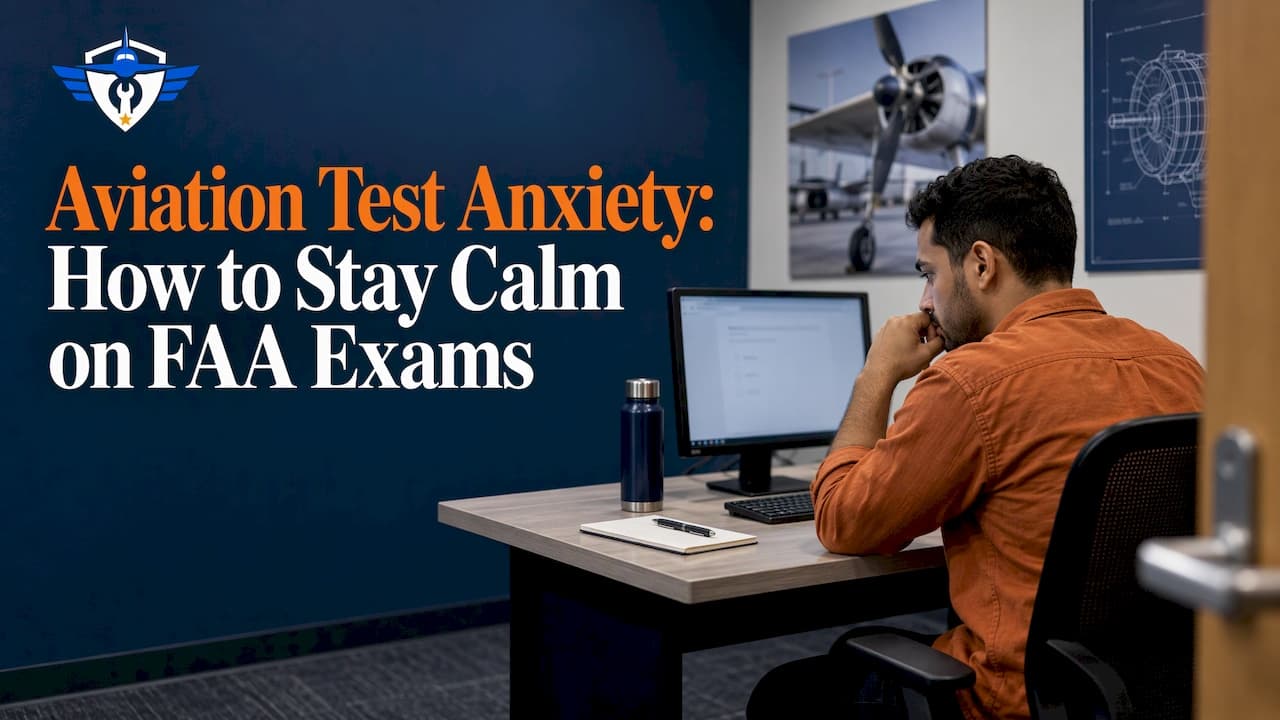
Aviation test anxiety is the nervousness, racing thoughts and blanking that hit before or during an FAA knowledge test, and it is manageable with preparation. The most reliable fix is to make the exam feel familiar: study with low-stakes self-testing, rehearse under timed conditions, build a short pre-test routine, and know exactly what to do when a question stumps you. This guide covers the A&P General, Airframe and Powerplant tests, plus the Part 107 drone exam.
TL;DR
- Some anxiety is normal. Research on FAA knowledge tests links anxiety to exam scores, so it is worth treating as a study skill, not a character flaw.
- Self-testing beats rereading. Timed practice tests teach the material and shrink the unknown at the same time.
- On test day, mark hard questions, move on, and come back. The FAA itself advises this.
- Sleep, exercise and a daily relaxation habit do more than a last-night cram.
- If anxiety keeps interfering with concentration, talk to your instructor and a professional counselor. Accommodations exist.
Table of Contents
- Why aviation exams trigger anxiety
- Build confidence before test day
- A plan by exam
- Test-day tactics that work
- Sleep, exercise and the unglamorous basics
- When anxiety needs more than a study plan
- Perspective: why we build practice around your misses
- Practice that fits your plan
- FAQ
- Sources
Why aviation exams trigger anxiety
A knowledge test is a gate. Pass General, Airframe and Powerplant, and you move toward your mechanic certificate. For a Part 107 applicant, it is the only barrier between you and a commercial drone job. When one result decides what happens next, the brain treats it as a threat.
This is not just anecdote. A 2010 study of FAA knowledge tests by Sloan and colleagues found that, in authentic testing environments, both debilitating test anxiety and facilitating anxiety correlated significantly with FAA exam scores. In plain terms: a little arousal can sharpen you, while too much gets in the way.
The same paper describes how the debilitating kind shows up in trainees: excessive nervousness, frustration and a feeling of inadequacy that can drag assessments down. If that sounds like you, you are not unusual, and you are not behind.
What it looks like in practice
Aviation students tend to describe the same patterns:
- Knowing a topic cold at home, then blanking on a similar question in the testing center.
- Rereading a question four times and still not absorbing it.
- Spending ten minutes on one hard question and then rushing the last twenty.
- Dreading the test for weeks, which leads to avoiding study, which raises the dread.
Each of these has a practical countermeasure, and none of them requires you to "just relax."
Build confidence before test day
Most anxiety is anticipation of the unknown: unknown questions, unknown pacing, unknown weak spots. The best preparation attacks each of those directly.
Study early, not at the last minute
Mayo Clinic's guidance on test anxiety recommends learning efficient study habits and studying early rather than cramming. For an A&P student, that means working through the FAA's Airman Certification Standards (ACS) topic by topic over weeks, not rereading handbooks the weekend before.
A simple rhythm works for most people:
- Pick one ACS area per study session.
- Read or review it briefly.
- Close the book and test yourself on it.
- Log what you missed and revisit it within two or three days.
Test yourself instead of rereading
Rereading feels productive because the page looks familiar. Retrieval, pulling answers out of memory, is what actually builds recall. Scientific American reports that hundreds of studies find retrieval practice improves retention more than rereading, citing a 2008 experiment in which self-tested students remembered about 80% of vocabulary words later, versus roughly one-third for those who simply reread.
There is a calming side effect. When you have answered hundreds of questions under realistic conditions, a real test question looks like something you have already done. That familiarity is what lowers the threat response.

Practice under test-like conditions
Mayo Clinic also advises practicing in a consistent or test-like setting. For FAA tests that means full-length, timed runs: no phone, no notes, one sitting. If your only practice has been ten casual questions on the couch, the real clock will feel like a shock.
The FAA's AMT ACS Companion Guide states that the Airframe test has 100 multiple-choice questions, allows 2.0 hours and requires a 70 to pass. Do the math before you sit: that is roughly a minute and a bit per question with a little room to review. Practice at that pace until it feels ordinary.

Track what you keep missing
Vague worry ("I don't know if I'm ready") fuels anxiety. Specific data ("I miss electrical system questions about 40% of the time") turns it into a to-do list. Keep a running log of missed topics, or use a tool that tracks high-miss topics for you, and spend your time there instead of on material you already own.
A plan by exam
The core strategy is the same everywhere, but each test has its own pressure points.
General (AMG)
General is the first test most mechanics take, so it carries first-exam nerves on top of everything else. The content is broad: math, physics, regulations, maintenance publications, ground handling, and more. Breadth is the anxiety trigger here, because you cannot know every question will touch what you reviewed last.
The FAA says plainly in the Companion Guide that the written test can only sample the vast amount of knowledge every mechanic needs, and applicants are responsible for demonstrating acceptable knowledge of the standards in all subjects for their certificate and rating. Read that as reassurance and a study instruction: you cannot predict the sample, so cover the whole ACS evenly and use General practice tests to find the gaps.
Airframe (AMA)
Airframe is long and varied: structures, systems, electrical, hydraulics, landing gear, inspection. With 100 questions and a two-hour limit, pacing is the main stressor. Per the same FAA guide, the preparation materials include the Airframe handbook (FAA-H-8083-31, Volumes 1 and 2) and the ACS references.
A practical approach:
- Take one full timed run early to see where you stand without judging the score.
- Note which systems cost you the most time, not just points.
- Repeat timed runs weekly, and finish one in the last few days to rehearse the pace. Airframe practice tests make this easy to schedule.
Powerplant (AMP)
Powerplant anxiety usually comes from the number of distinct systems: reciprocating engines, turbine engines, ignition, fuel metering, induction, lubrication, propellers, and exhaust. Students often feel they have to be perfect on all of them. You do not. You need a passing score, and the ACS tells you what the test draws from.
Break the content into blocks and rotate through them. Test one block, review the misses, and move on. When a block keeps scoring poorly, ask your instructor to walk you through the concept on a real engine or a diagram instead of rereading the same paragraph. Powerplant practice tests with explanations help you see why an answer is right, which is what makes the next similar question feel easy.
Part 107 and drone pilot exams
Many Part 107 applicants are not career aviation people. They are photographers, surveyors, farmers and hobbyists, and the aviation vocabulary (airspace classes, sectional charts, weather reports) is new. That unfamiliarity is the anxiety.
The FAA encourages applicants to review the Airman Certification Standards, the Remote Pilot Study Guide and official online sample questions. The FAA's pilot Companion Guide adds two small tactics: read each question carefully, and use the test tutorial offered at the start of the session so the software is not a surprise. For a structured plan, see our Part 107 study plan.
Test-day tactics that work
Create a short pre-test routine
Mayo Clinic recommends establishing a pretest routine and practicing deep breathing or progressive muscle relaxation. Keep yours short and repeatable:
- Eat a normal meal and arrive early.
- Do two minutes of slow breathing in the car or waiting area.
- Remind yourself of your plan: first pass, mark, return.
Mayo also suggests practicing relaxation methods every day so they feel like a habit by test day. A technique you have never used before will not appear on command at the keyboard.
Mark, move and return
The FAA's 2024 AMT ACS Companion Guide advises applicants to mark a difficult question for review and come back to it after answering easier ones. That is the single best antidote to freezing. A hard question is not a verdict. It is one item out of dozens, and it will still be there in twenty minutes when your head is clearer.
The FAA's broader advice for Airframe applicants is also worth adopting: answer according to current regulations and guidance, and answer every question before time expires. A blank earns nothing, so a reasoned guess on the final pass beats leaving it open.
A simple pacing frame
On a 100-question, two-hour test, try this:
| Checkpoint | Target |
|---|---|
| First pass | Finish within about 80 to 90 minutes, marking hard items |
| Second pass | Work through marked questions |
| Final minutes | Make sure nothing is blank |
This is a rehearsal framework, not an FAA rule. Adjust it after your own timed practice runs.
When your mind blanks
Stop, put both feet on the floor, breathe out slowly, and reread the question once. Then eliminate answers you know are wrong. If nothing comes, mark it and move on. Blanking is usually a spike, and it passes.
Sleep, exercise and the unglamorous basics
Mayo Clinic includes adequate sleep and regular exercise among its test-anxiety recommendations. Students tend to skip both in the final week. Do the opposite. A 20-minute walk and a normal bedtime will help more than a fourth late-night review session.
A study schedule that protects these habits looks like this:
- Final heavy study day: three or four days before the test.
- Final two days: light review of your high-miss list only.
- Night before: stop studying early, pack your ID and any paperwork, and sleep.
When anxiety needs more than a study plan
Sometimes tips are not enough. Mayo Clinic advises talking with your teacher about test anxiety and seeing a professional counselor if needed, particularly when anxiety interferes with learning, focus or concentration. Consider reaching out if:
- You avoid studying because the thought of the test is overwhelming.
- You score well in practice but repeatedly freeze in real testing.
- Physical symptoms (a pounding heart, nausea, trouble sleeping) are severe or lasting.
Talk to your instructor first, and to a licensed counselor or your doctor for anxiety that goes beyond exam week. Research on aviation students, including work by Sloan and Wilson, discusses recognizing at-risk students early and using anxiety-reduction strategies. The earlier you ask, the more options you have. In the earlier Sloan study, a combination of cognitive, behavioral and study-skills approaches had the greatest effectiveness for reducing debilitating anxiety, which fits the layered plan in this guide.
Accommodations and retakes
If you have a learning or reading disability, you can request special accommodations for FAA knowledge tests. FAA Order 8080.6H covers this, and the pilot Companion Guide says requests can go through the PSI registration and scheduling process.
If you fail, it is not the end. Retesting applicants should bring an endorsement from an authorized instructor who provided the required additional training and certified that they are competent to pass, according to the FAA Companion Guide for pilots. Treat a failed attempt as data: the score report shows which areas to fix, and your next run is better informed than your first.
Perspective: why we build practice around your misses
Anxiety on an FAA exam is rarely about the material alone. It is about not knowing where you stand. Students tell themselves they might be unprepared, and without evidence they cannot disprove it.
That is why we built AMT Guides around performance tracking and high-miss topic analysis. Timed, full-length and topic-specific practice tests give you a realistic rehearsal, detailed explanations tell you why each answer is right, and the tracking shows exactly which topics need your time. When a concept stays unclear, you can seek help from an instructor instead of rereading alone.
For schools, instructor dashboards and analytics mean the same clarity applies to a whole class. An instructor can see which topics a cohort misses and intervene before test day, not after a failed attempt.
Confidence is not a feeling you wait for. It is a result of evidence, and practice with feedback is how you collect it.
the author
Practice that fits your plan
If you are ready to turn the advice above into a routine, AMT Guides offers timed full-length tests and topic-specific tests for General, Airframe, Powerplant and Part 107, with explanations and high-miss topic tracking. You can start with the Free plan at $0, move to Pro Monthly at $7.99 per month, or choose the AMT Student Pass at $89.00 one-off. Our student page explains how the tests work, and the ACS remediation and study plans page shows how misses turn into a focused review list.

Instructors and programs can look at instructor analytics or the school plans, which start with Starter at $279 per month or $2,988 per year. You can also request a demo to see how cohort data works.
FAQ
How do I manage test anxiety on the A&P exams?
Start studying early, test yourself with timed full-length practice, and build a short pre-test routine with slow breathing. Sleep and exercise matter too, as Mayo Clinic advises. On the exam, mark difficult questions and return to them after the easier ones.
Is it normal to have test anxiety before the Part 107 test?
Yes. The aviation vocabulary is new to many applicants, which makes the test feel riskier than it is. Review the FAA's ACS, Remote Pilot Study Guide and sample questions, and use the test tutorial before you begin. If you need accommodations, request them during PSI registration.
What should I do if I freeze or blank during the test?
Pause, breathe out slowly, reread the question once, and eliminate wrong answers. If it still will not come, mark it and move on. The FAA advises returning to hard questions after answering easier ones, and a calmer mind often finds the answer on the second pass.
When should I talk to someone about my anxiety?
If anxiety interferes with your concentration, learning or sleep, talk to your instructor and a professional counselor. Mayo Clinic recommends this when test anxiety substantially affects your studying or performance. Earlier help gives you more options before test day.
What happens if I fail an FAA knowledge test?
You can retest after additional training. The FAA says retesting applicants should bring an endorsement from an authorized instructor who gave the training and certified that you are competent to pass. Use the score report to target the topics you missed.
Sources
- The Use of Test Anxiety Assessment and Anxiety Reduction in FAA knowledge testing (Sloan et al., 2010)
- Test anxiety: Can it be treated? (Mayo Clinic)
- Done Right, Testing Enhances Learning (Scientific American)
- AMT ACS Companion Guide, 2022 (FAA)
- AMT ACS Companion Guide, 2024 (FAA)
- ACS Companion Guide for Pilots (FAA)
- Part 107 study materials (FAA)
- Order 8080.6H, Conduct of Airman Knowledge Tests (FAA)
- Assessment and Intervention Strategies for Test Anxiety in aviation students (Sloan and Wilson)