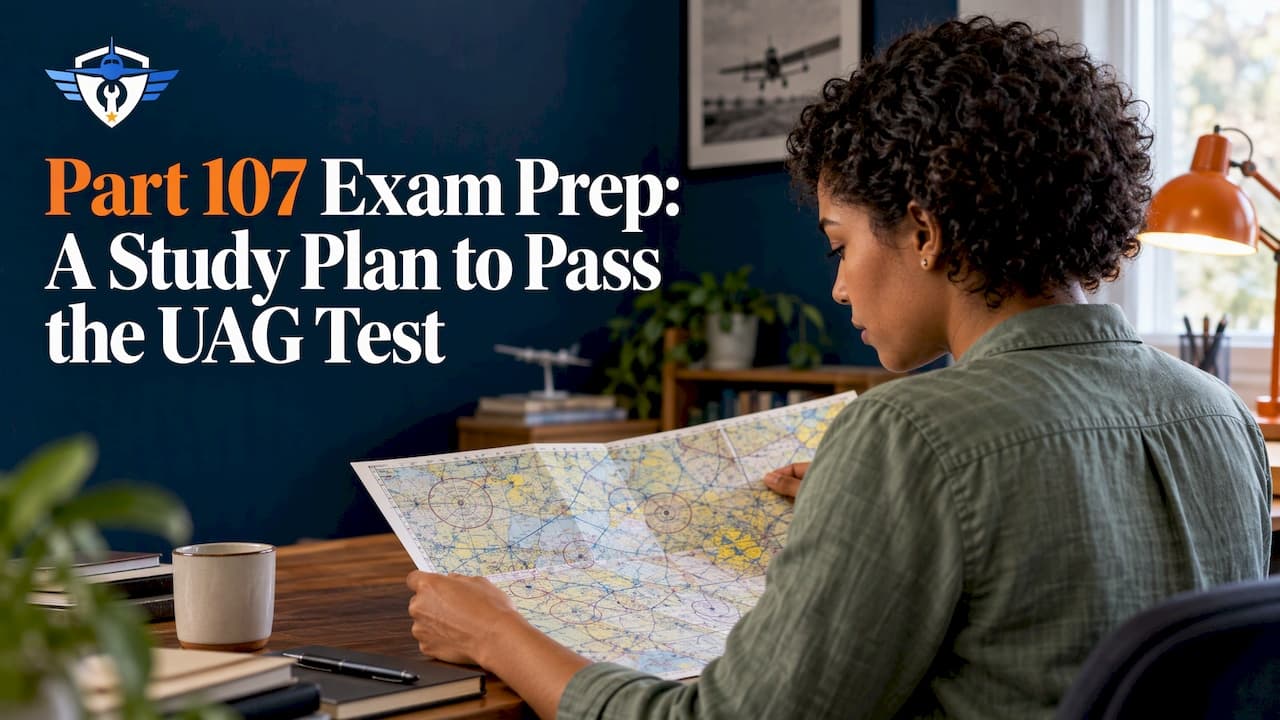
The best Part 107 exam prep combines three things: the FAA's own free study materials, timed full-length practice tests, and a written list of the topics you keep missing. Most candidates can organize all of that in about two weeks. This guide explains what the test is, how to register, and how to turn practice-test results into a study plan that fixes weak areas instead of rereading what you already know.
TL;DR
- To fly a drone commercially under Part 107 you need a Remote Pilot Certificate, and first-time applicants earn it by passing the Unmanned Aircraft General (UAG) knowledge test.
- The test has 60 questions and a passing score of 70 percent, and the FAA organizes its content into 12 knowledge areas.
- Start with a timed practice exam, write down your three weakest topics, drill those, then confirm progress with a second and third full-length test.
- If you fail, you wait 14 calendar days before retaking, so prepare to pass the first time.
- Our Part 107 practice tests, including a free tier, track your high-miss topics so you know what to study next.
Table of Contents
- What the Part 107 exam is and who needs it
- What the test covers
- Register for the test: the steps
- The official study materials, and what they are for
- A 14-day Part 107 study plan
- How to use practice-test results
- Test day and what comes after
- Part 107 compared with drone rules abroad
- Our perspective on Part 107 prep
- Practice with AMT Guides
- FAQ
- Sources
What the Part 107 exam is and who needs it
Part 107 is the FAA's Small UAS Rule. According to the FAA's page on becoming a certificated remote pilot, anyone flying a drone under that rule must hold a Remote Pilot Certificate. The certificate shows you understand the regulations, operating requirements and procedures for flying drones safely.
The typical person taking this exam is not a lifelong pilot. It is a real estate photographer, a roofing inspector, a surveyor, a farmer, a wedding videographer, a public safety volunteer or an aviation student adding a credential. If you are paid to fly, or fly in furtherance of a business, Part 107 is the path. Pure recreation falls under different rules, which is why the FAA keeps the recreational TRUST separate from this exam.
Eligibility basics
The FAA lists the requirements for the certificate. You must be:
- at least 16 years old,
- able to read, speak, write and understand English,
- in a physical and mental condition to fly a drone safely,
- and able to pass the initial aeronautical knowledge exam, Unmanned Aircraft General – Small (UAG).
The FAA also notes that eligible Part 61 certificate holders can use an online-training route instead of the knowledge test. If you already hold a pilot certificate other than student pilot, check the FAA page to see whether that path applies to you. Everyone else sits the UAG test.
What the test covers
The UAG test has 60 questions. AOPA's guide to remote pilot certification states you need at least 70 percent to pass, which means 42 correct answers out of 60. You receive a knowledge test report when you pass.
The content is not random. The FAA's Remote Pilot Study Guide organizes study material around the 12 knowledge areas that 14 CFR 107.73(a) requires:
- Applicable regulations
- Airspace classification and operating requirements
- Aviation weather sources and effects of weather on performance
- Small unmanned aircraft loading
- Emergency procedures
- Crew resource management
- Radio communication procedures
- Determining aircraft performance
- Physiological effects of drugs and alcohol
- Aeronautical decision-making and judgment
- Airport operations
- Maintenance and preflight inspection procedures
That list is your syllabus. It is also your scorecard: when you take practice tests, sort every missed question into one of those 12 buckets. Patterns show up quickly.
Where candidates usually lose points
The areas that tend to feel foreign to non-pilots are airspace (reading sectional chart symbols and knowing which airspace needs authorization), weather (reading METARs and TAFs), and performance and loading concepts such as density altitude and weight and balance effects. Regulations are the most memorizable area, but they are full of specifics. We cannot give you your personal weak spots in advance, and that is exactly why a diagnostic practice test comes first in the plan below.
Register for the test: the steps
The FAA's process has several steps, and it pays to start the paperwork early so you are not waiting on it. Based on the FAA's certification page:
- Confirm you meet the eligibility requirements listed above.
- Get an FAA Tracking Number (FTN) by creating a profile in IACRA. You need the FTN before you can register for a knowledge test.
- Schedule your appointment with an FAA-approved Knowledge Testing Center.
- Bring a government-issued photo ID on test day.
- Pass the UAG exam.
- Complete FAA Form 8710-13 in IACRA. You enter the 17-digit Knowledge Test Exam ID, which can take up to 48 hours from your test date to appear.
One separate item: the FAA's Part 107 newsroom page says every drone you fly under Part 107 must be registered at faadronezone.faa.gov, and the registration costs $5. Registering the aircraft is not the same as certifying the pilot, so you need both.
Fees and testing center schedules change, so confirm the current test fee and appointment availability with the testing center when you book.
The official study materials, and what they are for
The FAA says that study materials are available online and encourages applicants to review three things before the knowledge test:
- the Airman Certification Standards (ACS) for Unmanned Aircraft Systems,
- the Remote Pilot Study Guide,
- and the online sample questions.
Each plays a different role. The ACS tells you what the FAA expects you to know. The study guide teaches the content. Sample questions show you how the FAA words things. None of these gives you a realistic feel for a full 60-question sitting with a clock running, and none tells you which of your answers were wrong for the same underlying reason. That is the gap practice tests fill.
A 14-day Part 107 study plan
Plan two weeks if you are starting from zero and can study about an hour a day. If you already fly and know airspace, you can compress it. If aviation weather is brand new, stretch it. The structure below follows a diagnose, drill, verify rhythm.

Days 1 to 3: diagnose
Read the FAA study guide's table of contents so you know the terrain, then take a full-length practice exam under realistic conditions: timed, no notes, no pausing to look things up. Score it honestly. Then write down the three topics where you lost the most points. Not a vague feeling that you are bad at weather, but a count: weather, 6 misses; airspace, 5; regulations, 3.
Spend the rest of these days reading the study guide chapters that match those three topics first, not chapter one onward.
Days 4 to 7: drill the weak areas
Work topic-specific question sets from your three weak areas. For every miss, do not just read the right answer. Ask what rule, chart feature or formula made it right, and write that in one sentence. If you cannot explain why the three wrong options are wrong, you have not learned the concept yet.
Days 8 to 11: mixed practice
Switch to mixed question sets so you cannot predict the topic, which is how the real test feels. Then take a second full-length timed exam. Compare the topic counts with your first one. If a weak area is still dropping points, go back to drilling that area before moving on.
Days 12 to 14: final review and test conditions
Take a third full-length exam under test conditions: same time of day as your appointment if you can, nothing open beside you. Spend what is left on the handful of questions you still miss and on the ACS areas you have only skimmed. Rest the night before. Check your ID, your appointment time and the testing center address.
This cadence is a sensible template rather than an official FAA schedule. The principle underneath it is the part that matters: test first, study what the test reveals, test again.
How to use practice-test results
A practice score by itself is a thermometer, not a treatment. Candidates who only look at the percentage tend to retake the same test until they memorize it. Candidates who improve do four things:
- Categorize each miss into one of the 12 FAA knowledge areas.
- Separate knowledge gaps from careless errors. A misread chart legend is a different fix from not knowing the airspace classes.
- Track the repeat misses. A topic you miss three times across different questions is a real gap. A single miss may be noise.
- Aim for readiness, not a lucky score. The passing mark is 70 percent, so a margin above it across two or three full-length attempts is a healthier signal than one good run.
If you want a worked example of this approach for drone pilots, our Part 107 study plan article walks through it in more detail.
Test day and what comes after
Arrive early with your government-issued photo ID, since the testing center will not seat you without it. After you pass, complete Form 8710-13 in IACRA and enter your 17-digit Knowledge Test Exam ID. Remember it can take up to 48 hours to appear, so do not panic if it is missing the same afternoon.
If you do not pass, the FAA's ENR 8.5 publication says you must wait 14 calendar days before retaking the initial aeronautical knowledge test. It also confirms that no flight instructor endorsement is required before testing. Use those two weeks the way you would use the first two: look at which knowledge areas cost you points and rebuild the plan around them.
Part 107 compared with drone rules abroad
Our readers are worldwide, so one clarification: Part 107 is a U.S. credential. According to Commercial UAV News, a Part 107 certificate carries no legal weight in Europe, and there is no reciprocity agreement between the FAA and EASA. A U.S. operator wanting to fly commercially there has to register with a national aviation authority, get the relevant EASA competency certificates and follow local operating rules.

The frameworks also differ in design. Airsight's comparison describes the EU/UK approach as risk-based with Open, Specific and Certified categories, while Part 107 is a single certificate that covers drones under 55 pounds for commercial use, with night flights and flights over people generally needing special permission. If you plan to fly outside the U.S., study that country's rules separately.
Our perspective on Part 107 prep
Most people study for aviation exams backward. They read everything, take a test at the end, and find out in the testing center what they did not know. We built AMT Guides around the opposite order.
The thing that moves a score is knowing which topics you keep missing and getting help on exactly those. That is why our practice tests are built around performance tracking, high-miss topic analysis and targeted remediation, and why the same approach runs through our individual plans and our classroom tools. A timed full-length test tells you where you stand. A topic-specific set lets you work on the gap. Detailed explanations tell you why the right answer is right.
We came to this from FAA certification prep, where students and instructors need data, not guesses. Part 107 candidates face the same problem on a smaller scale: a 60-question test, 12 knowledge areas, and a short window to get ready. If you let your results tell you what to study, two weeks is a realistic plan.
the author
Practice with AMT Guides
Our FAA practice tests include Part 107 Remote Pilot exam prep: timed full-length tests, topic-specific tests, detailed question explanations and high-miss topic tracking, so the diagnose, drill, verify cycle above has a tool behind it.
If you want to begin without paying, the Free plan costs $0. The Pro Monthly plan is $7.99 per month, and the AMT Student Pass is a one-off $89.00. You can see all three on our plans page.

Instructors and programs that teach Part 107 alongside A&P content can look at our school plans, which add instructor dashboards and analytics so teachers can see which topics a whole cohort is missing.
FAQ
How many questions are on the Part 107 test, and what score do I need?
The UAG knowledge test has 60 questions, and AOPA's guide states you need at least 70 percent to pass. That works out to 42 correct answers. Passing earns you the knowledge test report you need for the certificate application.
How long should I study for Part 107?
Two weeks of about an hour a day is a workable plan for a beginner. It covers a diagnostic exam, focused work on your three weakest topics, mixed practice and a final full-length test. Experienced pilots may need less, and anyone new to weather and airspace may need more.
What happens if I fail the exam?
The FAA requires a wait of 14 calendar days before you can retake the initial aeronautical knowledge test. No instructor endorsement is needed. Use the wait to sort your missed questions by knowledge area and rebuild your study plan around them.
What do I need to bring to the testing center?
Bring a government-issued photo ID. You also need an FAA Tracking Number from an IACRA profile before you can register for the test. After passing, you complete Form 8710-13 in IACRA with your 17-digit Knowledge Test Exam ID.
Can I use my Part 107 certificate to fly commercially in Europe?
No. The certificate has no legal weight in Europe, and the FAA and EASA have no reciprocity agreement. You would need to register with a national aviation authority and obtain the relevant EASA competency certificates.
Sources
- FAA: Become a Certificated Remote Pilot
- FAA: Remote Pilot Small UAS Study Guide
- AOPA: Guide to Remote Pilot Certification
- FAA: Small Unmanned Aircraft Systems (UAS) Regulations (Part 107)
- FAA: Where can I find study materials for the Part 107 knowledge test
- FAA: ENR 8.5 UAS Pilot Testing, Certification and Responsibilities
- Commercial UAV News: Crossing the Atlantic with a Drone
- Airsight: Global Drone Regulations, EU/UK and US